Migration automation for SaaS platforms and the teams switching to them
Your setup took months to build.
Moving it shouldn't take months too.
Beena migrates data, workflows, templates, and configurations between software platforms. Whether you're switching tools yourself or helping your customers do it, the setup arrives intact.
Two ways to work with Beena
I'm switching platforms
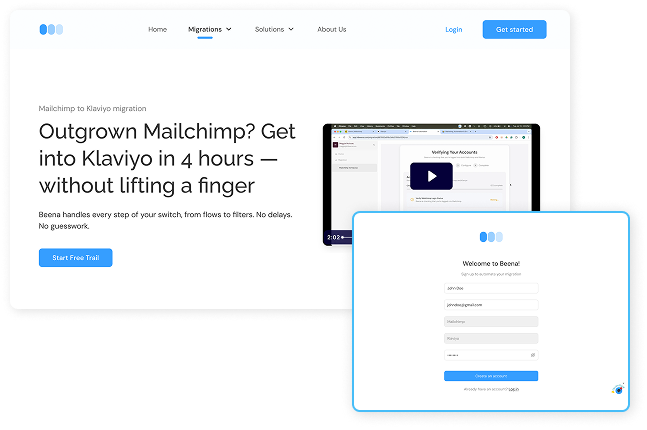
You're a marketer or operator moving off a tool you've outgrown. Beena copies your data, templates, flows, and segments into your new platform so you don't spend weeks rebuilding what you already had. Mailchimp to Klaviyo is live today. More paths coming.
Learn more →My platform needs to offer migrations
You're a SaaS company and migration friction is costing you deals. Beena builds and maintains the migration automation for your platform. Your prospects arrive with their setup already in place. Free POC on your top migration pair. Live in days.
Learn more →What has to move
Customers who switch arrive in your product with nothing carried over. The first weeks rebuilding what they already had is where most give up.
Records and history
Customer records, account history, custom fields. Built up over years. All of it has to transfer cleanly or the new platform starts from zero.
Segments and filters
The logic for organizing and targeting customers takes months to build. Prospects won't switch if they have to rebuild it from scratch.
Automated workflows
Triggers, sequences, and rules that run in the background. Some accounts have dozens. The more complex they are, the harder they are to recreate manually.
Content and templates
Templates, articles, and content refined over time. Recreating them manually takes weeks and introduces errors.
Configuration and settings
Permissions, integrations, and platform-specific settings. Easy to overlook during a migration. Hard to fix after a customer has gone live.
How it works
Beena sets up the migration automation using technology we've already built. Your team decides how customers use it.
Beena sets up the automation STEP 1
We build and configure the migration from your top competitor sources. Because the core technology already exists, standard automations are testable in days, not months.
Self-service or white-glove STEP 2
Customers can run the migration themselves before or during evaluation. Or your team runs it on their behalf for a more hands-on experience. Both use the same Beena automation.
They arrive ready STEP 3
Customers land in your platform with their data and configurations already in place. No rebuilding required. Your onboarding team picks up from a running start.
Building migration in-house vs. partnering with Beena
What changes when migration isn't the bottleneck
Migration complexity is a top reason competitive deals stall in most SaaS categories. Removing it changes the conversation.
More competitive deals close
Prospects who were afraid to switch because of migration complexity now have a clear path. Your team spends less time on objection handling.
Faster time to live
Customers arrive in your platform with their data already there. Onboarding starts from a running start, not from an empty account.
No build or maintenance burden
Beena builds the migration automation, maintains it, and updates it when source platforms change. Your engineering team stays on your product.
Data stays on device
Migrations run locally on the customer's machine. No data passes through Beena's servers. Same security posture as your customer logging in manually.
Ready to move?
Whether you're switching platforms yourself or building migration into your product, start here.